
Jul 24, 2026
How to Conduct a GEO Audit (Generative Engine Optimization): A Step-by-Step Guide (2026)
A GEO audit (Generative Engine Optimization audit) tells you how your brand shows up across AI engines like ChatGPT, Perplexity, and Gemini, and where it stays invisible. This guide breaks the process down into eleven actionable steps, from defining your scope to building your GEO roadmap.
What Is a GEO Audit?
A GEO audit (Generative Engine Optimization audit) is a structured review of how a brand shows up across generative engines like ChatGPT, Perplexity, Gemini, Claude, Grok, and Microsoft Copilot, as well as AI-powered search features like Google AI Overviews, Google AI Mode, and Bing Copilot Search. It maps where your brand gets cited, mentioned, and recommended in AI answers and where it stays invisible.
The goal is simple: turn AI visibility from a black box into a prioritized list of opportunities you can act on.
A complete GEO audit looks at five things:
Scope : the topics and prompts that actually matter to your buyers, the foundation everything else is measured against.
Technical and content readiness : whether AI crawlers can reach, read, and chunk your pages, and whether your content is built to be extracted and quoted.
Visibility and answer quality : how often you get cited and mentioned, and whether AI answers match your messaging and stay positive about your brand.
Off-site influence : the sources, domains, and social platforms that feed AI answers on your topics.
Competition : where rivals get surfaced and recommended while you stay out of the answer.
Together, these five layers map to the step-by-step audit below. The audit is the starting point of your GEO strategy, not a one-off snapshot.
How is a GEO audit different from an SEO audit?
The levers are the same ones you already use in SEO: creating content, optimizing existing content, earning mentions through editorial or sponsored placements. What changes is the scope you analyze, and that changes the detail of the actions you take.
You will also run into adjacent terms: AEO (Answer Engine Optimization) and LLMO (Large Language Model Optimization). They name the same shift, and a GEO audit covers what they describe.
Two things shift in particular.
The surface is wider. An SEO audit looks at one engine: Google's results page. A GEO audit looks at every engine that now answers your buyers. They fall into two families:
LLMs : ChatGPT, Google Gemini, Claude, Perplexity, Microsoft Copilot
AI-powered search features : Google AI Overviews, Google AI Mode, Bing Copilot Search
The grain is finer. In SEO you work at the keyword level, and a keyword usually bundles several intents. In GEO you work at the prompt level, and a prompt carries a single intent with its full context. That makes GEO far more micro and contextual: you measure visibility prompt by prompt, not keyword by keyword.
Here is how the two compare:
SEO audit | GEO audit | |
|---|---|---|
What you analyze | Rankings, clicks, impressions | Citations, mentions, share of voice |
Where | Google (one SERP) | 5+ engines and AI search features |
How content is picked | Crawl, index, rank 10 links | Retrieve, ground, synthesize one answer |
Unit of intent | Keyword (several intents) | Prompt (one contextual intent) |
Output the user sees | A list of blue links | One answer with brand mentions and a few cited sources |
How you measure | GSC / SEO tool | GEO specialized tool |
One thing to be honest about: a GEO audit does not replace an SEO audit, it assumes one. Part of your GEO performance flows directly from your SEO performance. LLMs lean heavily on search engine indexes like Google's to ground their answers, a process known as retrieval-augmented generation (RAG). They often expand a single prompt into a query fan-out of related searches, then pull the pages already winning in classic search. Auditing your SEO foundation is not optional, it's where a serious GEO audit starts.
If you want to learn more, consult our dedicated article about the difference between SEO and GEO.
How to Conduct a GEO Audit Step by Step?
The audit runs in eleven steps, from defining your scope to formalizing your roadmap. Here is how to work through each one.
Step 1 : Define the scope
A clean scope is the foundation of the whole audit. Everything you measure and every conclusion you draw rests on it. Get it wrong and your data is just noise.
Three things define your scope:
Brand analyzed : the brand you want to track.
Topics analyzed : the themes you group your prompts under.
Prompts per topic : the actual questions you run through the engines.
How to define your GEO topics?
Splitting your scope into clean topics is what keeps the analysis readable. A topic in GEO works like a semantic cluster in SEO: a group of prompts that share the same intent space.
Take a global bank. Its top-level topics could be:
Topic 1 : Mortgages
Topic 2 : Business loans
Topic 3 : Wealth management
The more search volume a topic holds, and the more granular the queries inside it, the more it pays to resegment. Same bank, zooming into Mortgages:
Topic 1 : First-time buyer mortgages
Topic 2 : Refinancing
Topic 3 : Buy-to-let mortgages
How to define your prompts for each topic?
Stay bottom funnel. In GEO you have no per-prompt volume data: nothing tells you how often a given prompt is actually typed into an engine. So you stay as close as possible to what your buyers are most likely to ask, which means the bottom-funnel queries they use when they are close to choosing a vendor. Aim for 20 to 50 prompts per topic. Tracking 200 prompts in one topic dilutes your reading and tells you nothing actionable.
To build the list, lean on proxies you already have:
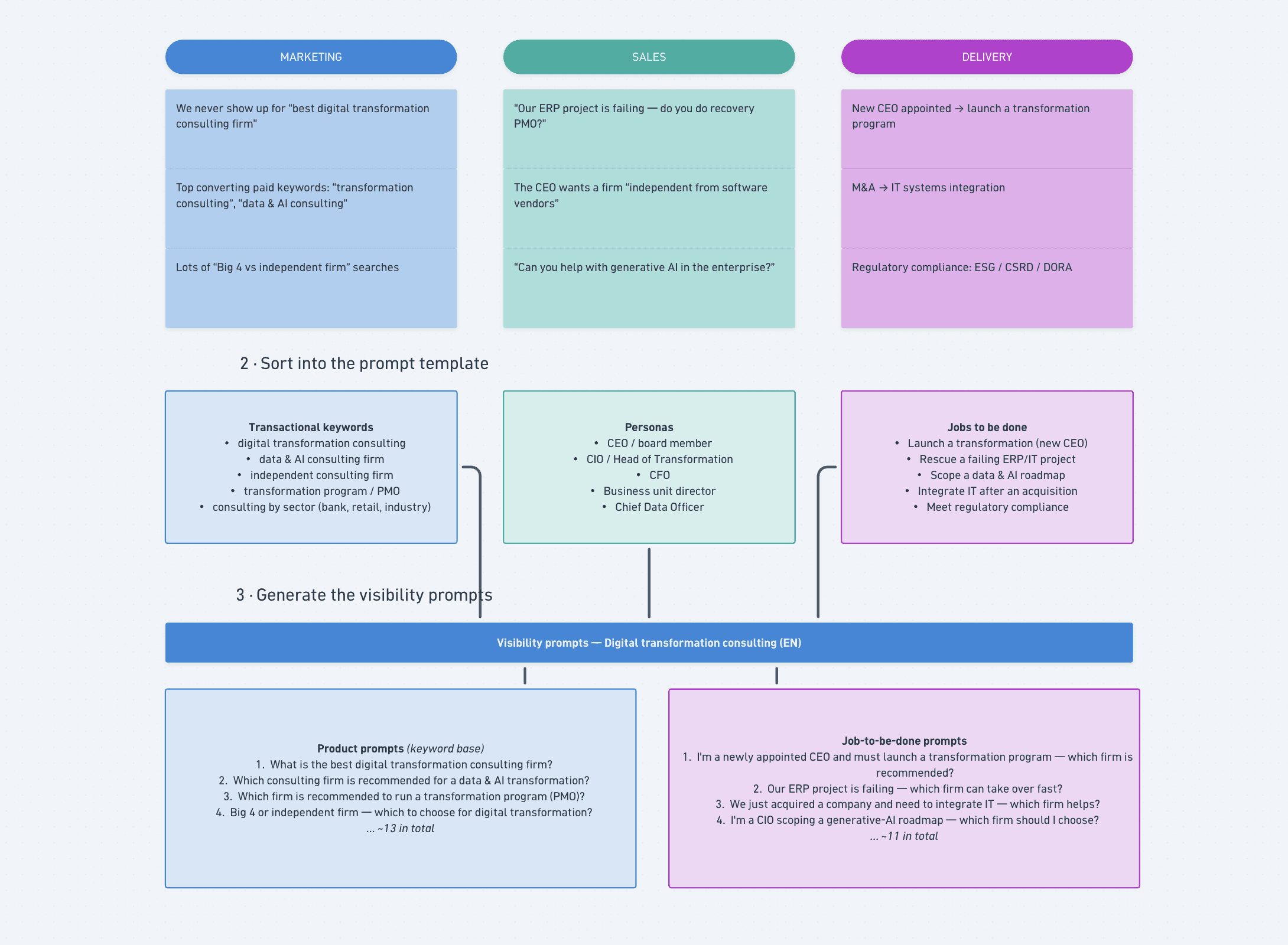
Transactional keywords : your existing bottom-funnel search data.
Sales call transcripts : the exact wording prospects use.
Log analysis : the queries AI bots already pull your pages for.
Important : logs are a strong proxy, but separate the live-retrieval user-agents (OAI-SearchBot, PerplexityBot) from the training crawlers (GPTBot, ClaudeBot, Google-Extended). Only the retrieval bots tell you what actually feeds live answers.
Advice : run a short workshop with marketing, sales, and product to build the prompt list together. Each team hears a different version of the questions your buyers ask AI.
Step 2 : Collect your GEO data
Your scope is set and you know which GEO KPIs to track. Now you collect the data the whole analysis will sit on.
What KPIs should I track in my GEO audit?
KPI | What it measures | Source |
|---|---|---|
AI share of voice | Your brand's slice of total brand visibility across answers on your scope | GEO tool |
Citation rate | How often your site is linked as a source in answers | GEO tool |
Mention rate | How often your brand is named in the answer text | GEO tool |
Alignment | Whether the way engines describe you matches your messaging | GEO tool |
Sentiment | Whether engines speak about your brand positively or negatively | GEO tool |
Traffic | Visits AI engines actually send to your site | Analytics |
Conversion | Revenue actions coming from that AI traffic | Analytics |
Use an AI Search Visibility tool
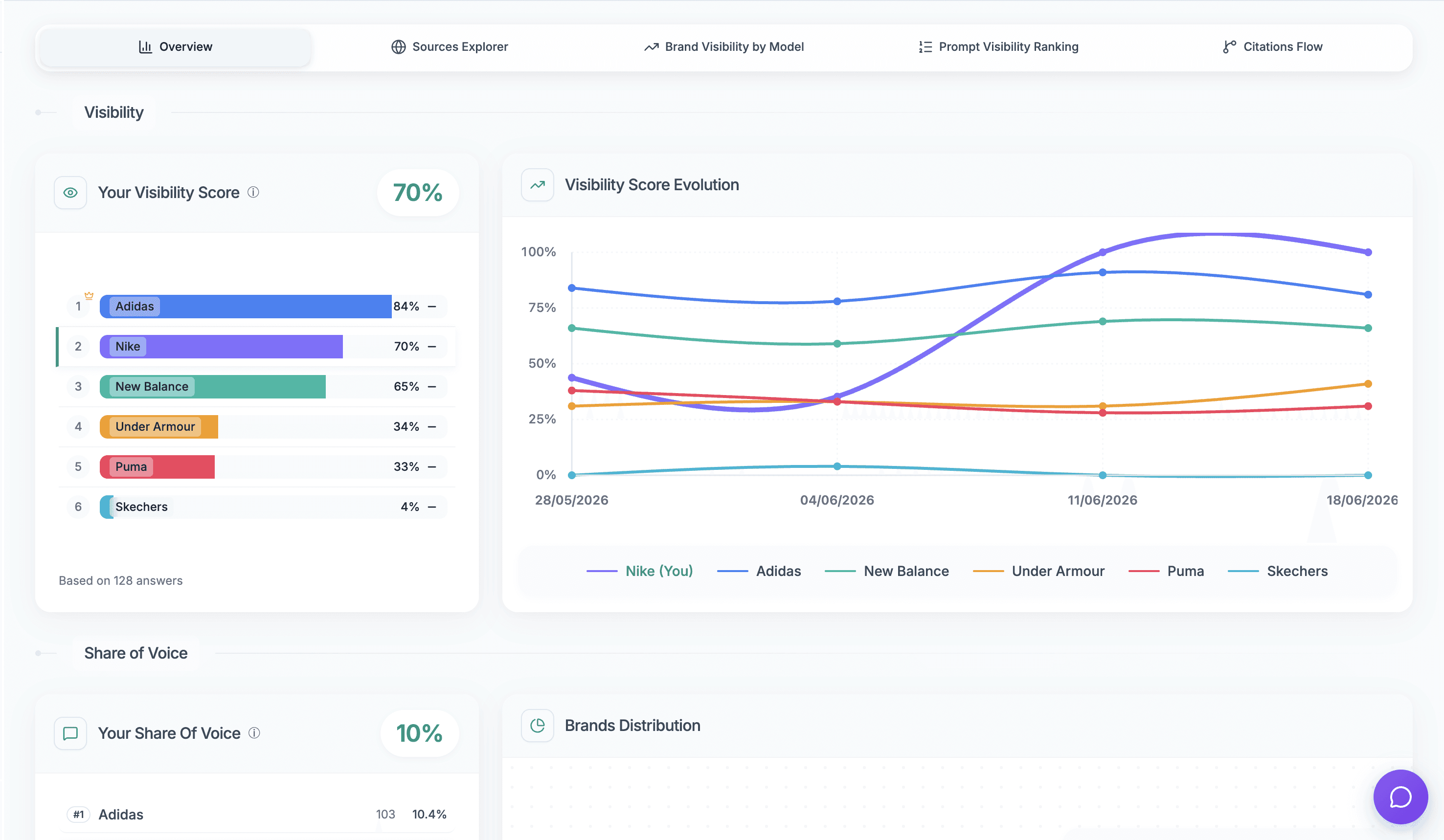
Run all your prompts through the generative engines (ChatGPT, Claude, Perplexity, Gemini) with a platform like GetMint. It simulates your full prompt set and returns the first five KPIs.
Important : LLM answers are impermanent. The same prompt can surface different brands and sources from one run to the next. Run each prompt multiple times and spread the runs over time, around 15 runs per engine at roughly one per day, to smooth out this day-to-day variation and reach a stable baseline.
Use your historical marketing data
To complete the base, check whether generative engines already send you traffic and conversions. Any analytics platform that records referrers works here, GA4, HubSpot, or whichever tool you run. Since May 2026, GA4 even has a native "AI Assistant" channel that tags these sessions automatically.
Two detection mechanisms, depending on the engine:
ChatGPT appends a source parameter to its links : www.yourbrand.com/?utm_source=chatgpt.com
Perplexity, Claude and Gemini are caught by their referrer : perplexity.ai, claude.ai, gemini.google.com
Important : a large share of AI traffic (35% to 70% depending on the source) arrives with no referrer and lands in "Direct", especially from the ChatGPT mobile app. Treat what you measure as a floor, not the full volume.
Step 3 : Audit technical accessibility for AI bots
For an LLM to mention your brand and cite your site, it has to do three things: reach and crawl your pages, read their content, and chunk that content to reuse it in an answer. Several checks tell you whether that chain holds.
Double check your robots.txt
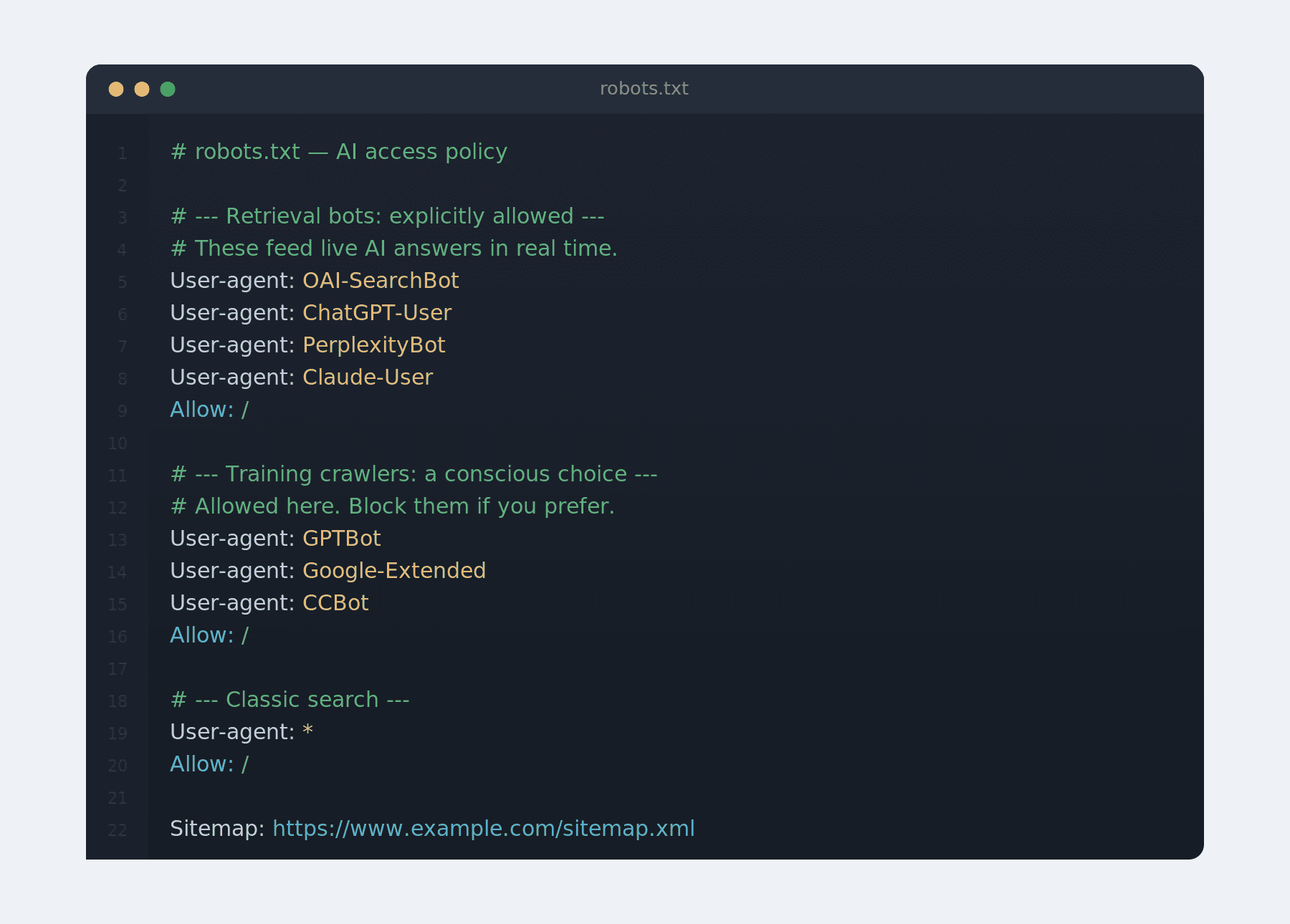
Your robots.txt decides which AI user-agents are allowed in. Two families matter:
Training crawlers (GPTBot, Google-Extended, ClaudeBot) feed model training. Blocking them is a legitimate strategic choice.
Retrieval bots (OAI-SearchBot, PerplexityBot) fetch pages live to build answers. Block these and you lose any chance of being cited.
What to do: explicitly allow the retrieval bots, and make a conscious call on the training ones. What to avoid: a blanket Disallow: /, a leftover staging block, or blocking a retrieval bot by accident. That is the most common way a brand makes itself invisible to AI.
Analyze your AI crawl logs
Look at which pages AI bots crawl and which they skip. If important pages are rarely or never crawled, dig into the cause. Keep separating retrieval bots from training crawlers: only the retrieval ones tell you what actually feeds live answers.
Identify JavaScript rendering problems
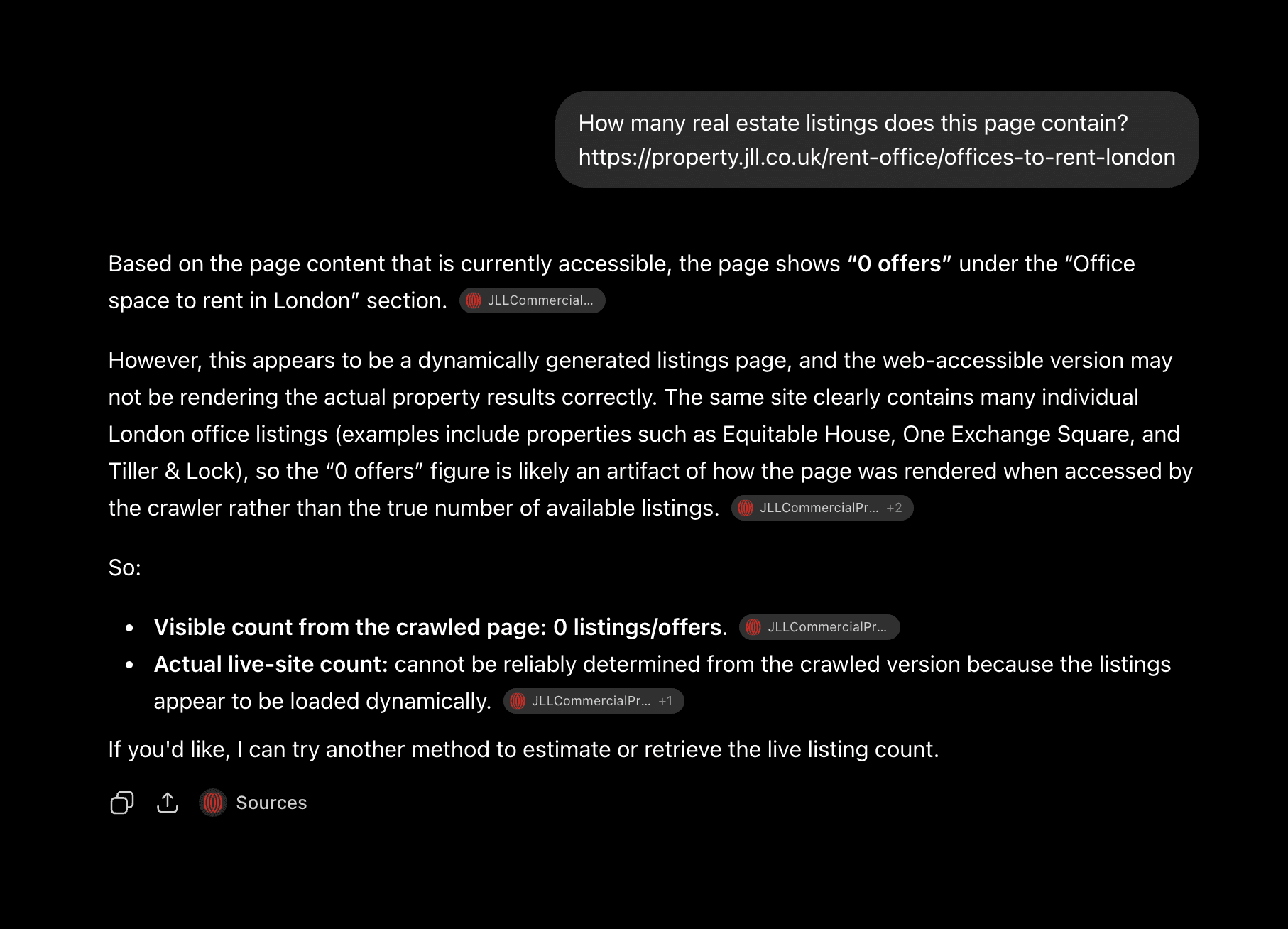
Like Google a few years ago, LLMs struggle to read content hidden behind JavaScript. This is the dynamic vs static content problem: static HTML is readable, while content injected client-side often is not. If your key content loads dynamically, the bot sees an empty shell.
Take a large commercial real estate firm. Ask ChatGPT to list the offices on one of its listing pages and it answers that the page shows "0 annonces ... likely because the listings are loaded dynamically." The listings load through client-side JavaScript: the server returns empty containers and the text is injected afterward. ChatGPT does not execute JavaScript, so it reads zero listings on the page. Competitors serving the same content in raw HTML get their listing pages cited more often. The fix is to serve that content in the initial HTML, through server-side rendering or prerendering.
Two more signals help the bot read you: keep your page speed healthy, and use semantic HTML so the structure of your content is machine-readable.
What about llms.txt?
llms.txt is a proposed standard: a file that points AI engines to your most important content. Its impact is not proven yet, but it costs nothing to ship. Some brands go further with a dedicated AI info page, like Lemlist's. The standard is documented at llmstxt.org.
Step 4 : Audit your content structure
When an LLM looks for information, it rarely reads a full page right away. It first scans relevance signals to decide which pages are worth analyzing:
Meta titles and descriptions : do they state clearly what the page is about?
URL structure : is it readable and descriptive?
Structured data : schema.org markup that spells out what a page contains. Useful types include FAQ, HowTo, Article, Product or Organization schema, but the right ones depend on your business and site type.
Once the LLM decides to go deeper, your content has to be easy to extract and reuse. Audit it against four rules:
One main idea per section : self-contained blocks an engine can lift without losing context.
Headings that answer real questions : phrase your H2s and H3s the way buyers ask AI engines.
A TLDR : a short, quotable summary the model can pull directly.
An FAQ built from your actual prompts : reuse the questions from your scope.
Structure gets you read. Trust gets you cited. Engines lean toward sources they find credible, so reinforce your authority signals: clear author credentials and expertise (E-E-A-T), links to reliable references, and original insights or first-hand data instead of commodity content. Stay fresh too, since AI engines favor recency: refresh key pages and keep your timestamps up to date.
Across both phases the goal is the same: make the extraction work as easy as possible for the LLM.
Step 5 : Analyze your GEO KPIs on each topic and prompts
Analyze your GEO visibility at the macro and micro level
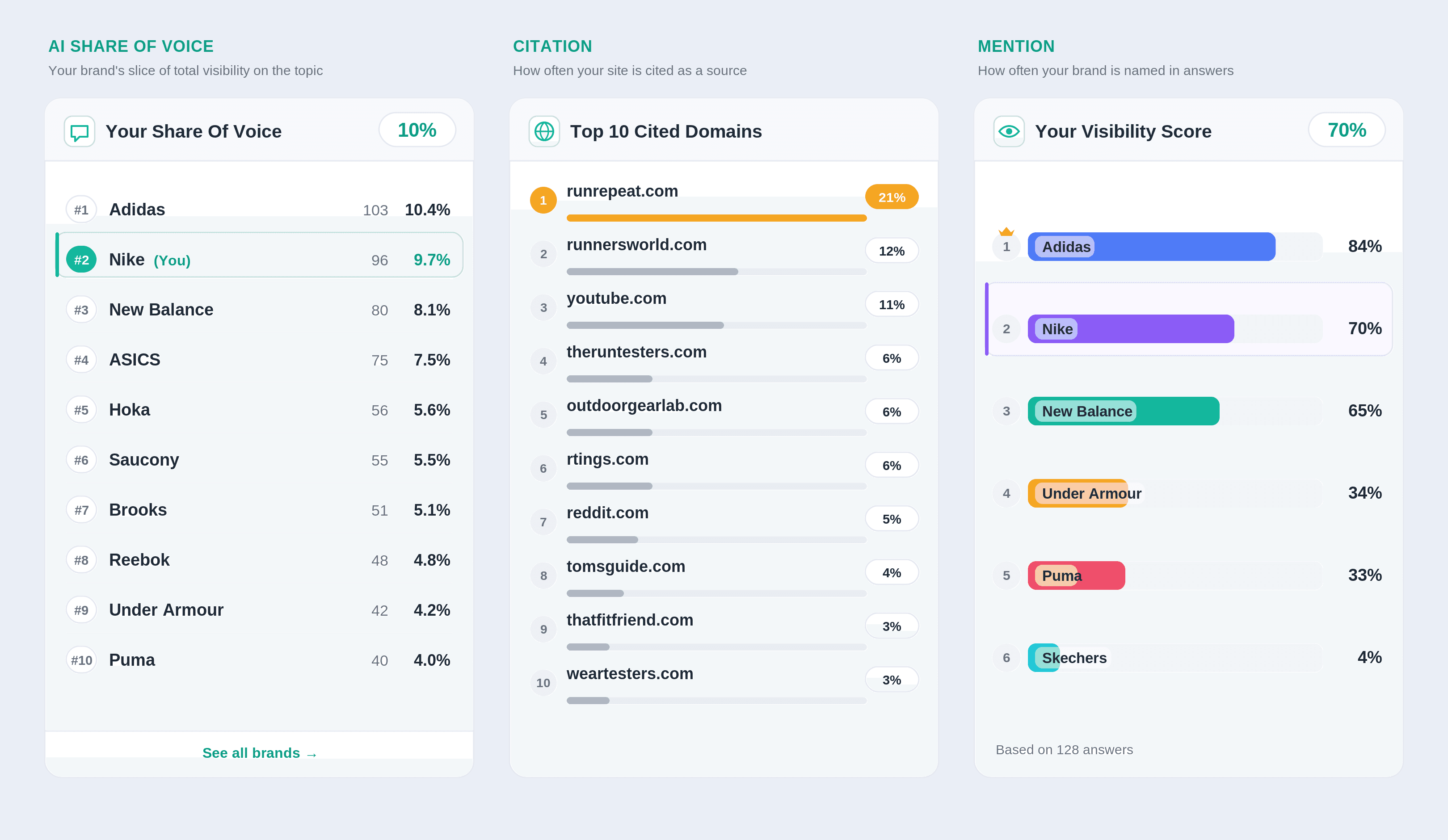
Work at two levels: macro (topic) and micro (prompt). For each topic, start with your visibility KPIs:
AI share of voice : your brand's slice of total visibility on the topic.
Citation : how often your site is cited as a source in answers.
Mention : how often your brand is named in the answer text.
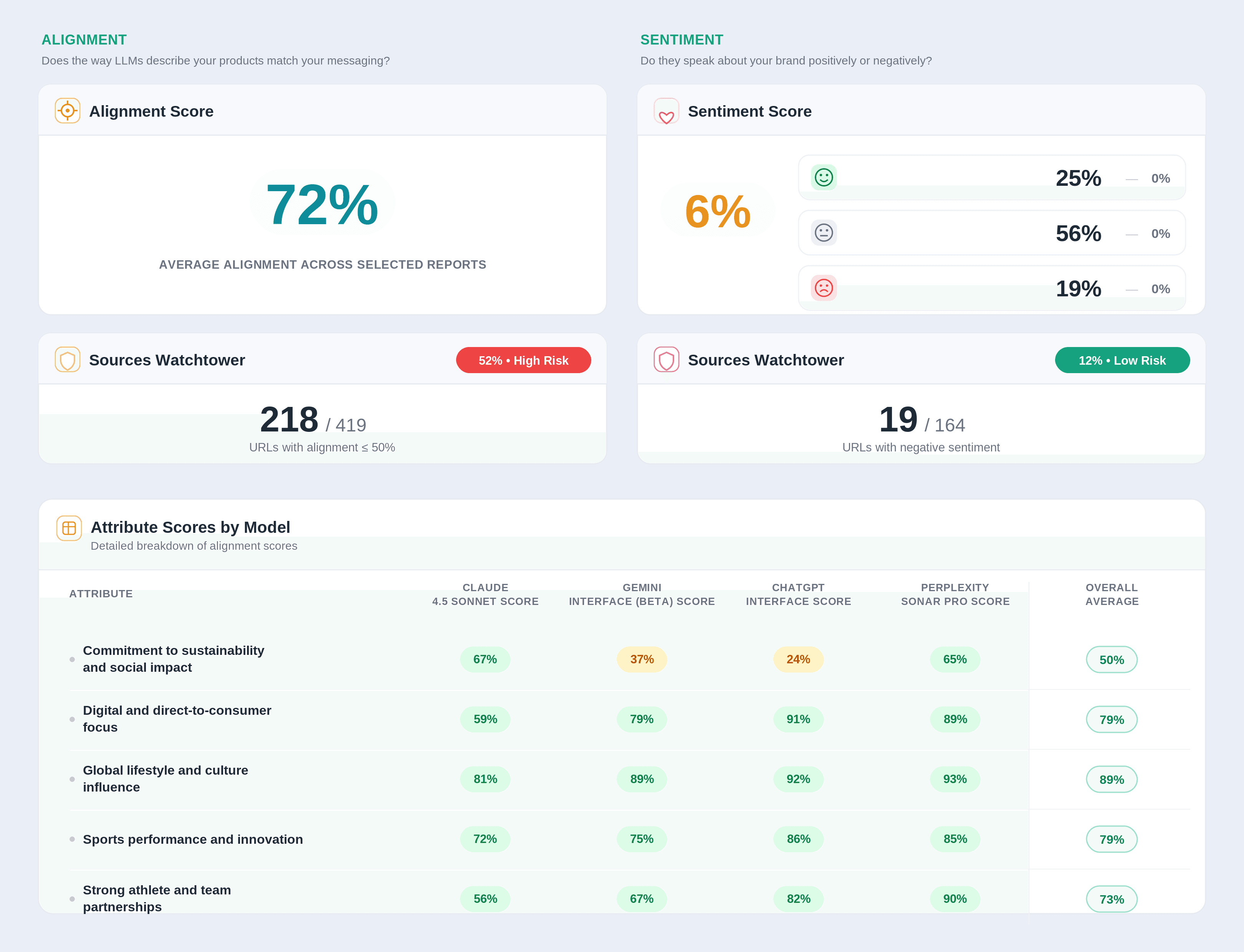
Then read the two brand-health KPIs:
Alignment : whether the way LLMs describe your products matches your messaging.
Sentiment : whether they speak about your brand positively or negatively.
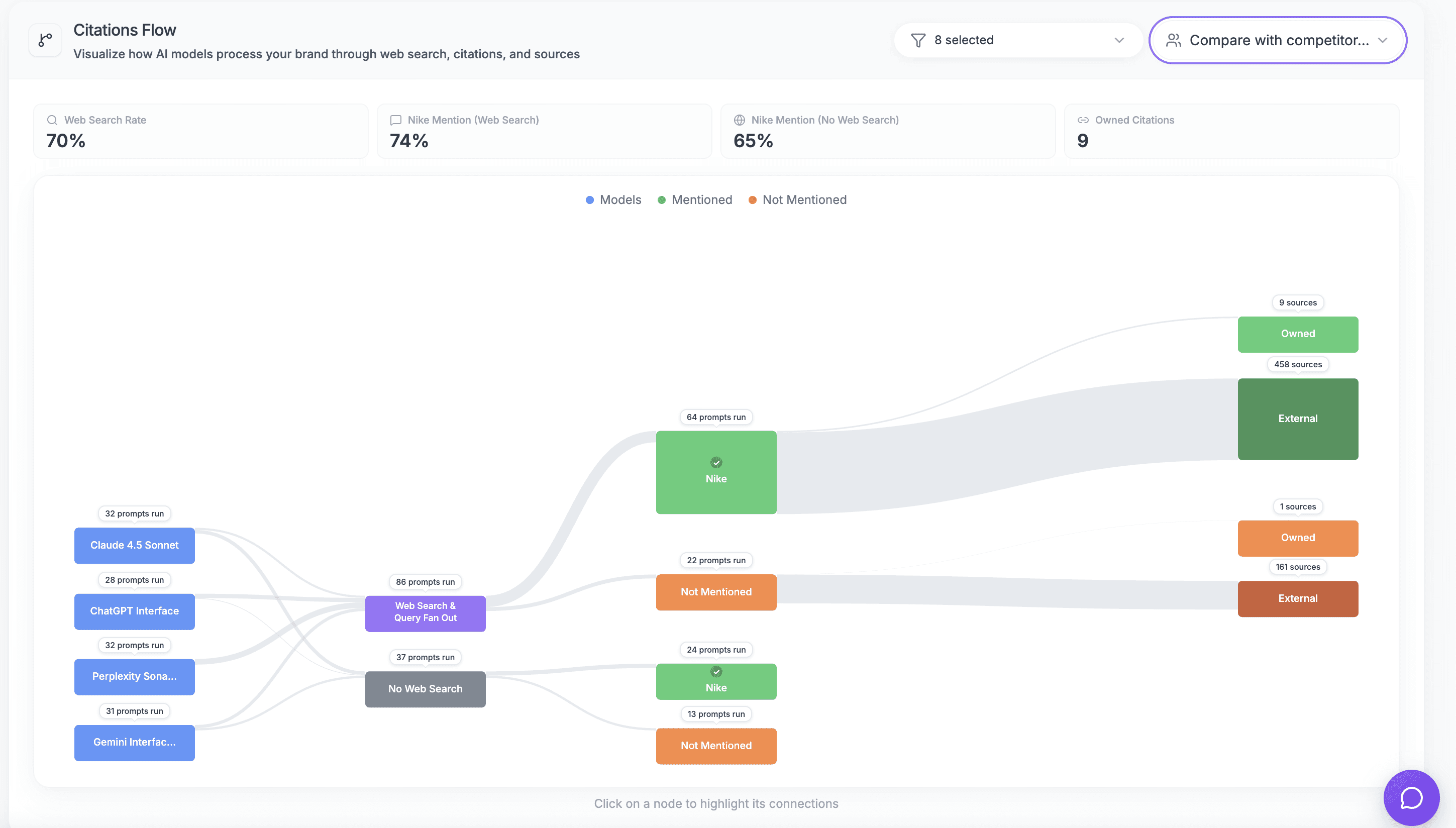
Then answer one question: is your visibility driven by on-site or external factors? GetMint's Citations Flow settles it in minutes. It's a Sankey diagram that traces how each model processes your brand, from the prompt, through web search, to whether you get mentioned, down to whether the cited sources are your own pages (owned) or third-party sites (external).
Start with a macro baseline at the topic level: your share of voice, your citation and mention rates, plus your query coverage (the share of prompts where you appear at all) and your response inclusion rate (how often you land in the final answer). Then go micro, prompt by prompt. Some prompts will surface your brand far more than others, and the weak ones are where the work sits.
At the micro level, also look at the query fan-out: the sub-queries an engine generates from a single prompt to fetch its sources. They reveal the exact searches you need to win. When a prompt fans out into queries where your pages are absent from classic search, that is usually why you are not cited, and it ties straight back to your SEO foundation.
Split your GEO analysis by engine
You can be strong on ChatGPT and weak on Perplexity. So break your key KPIs down by engine instead of reading a single average that hides where you win or lose.
Do it across both families:
LLMs : ChatGPT, Claude, Perplexity, Gemini
AI search features : Google AI Overviews, Google AI Mode, Bing Copilot Search
Each engine retrieves and cites differently, so the same brand can have very different visibility from one to the next. How to rank in ChatGPT is slightly different from how to rank in Perplexity, same baseline, but different levers on each generative engine.
Step 6 : Perform GEO competitive analysis to identify content gap
Run the same analysis you ran on yourself, but on your competitors. On each topic, benchmark your KPIs against theirs:
AI share of voice
Citation rate
Mention rate
You can do this at the topic level, and drill down to a single prompt when you need precision. The goal is to find content gaps: content your competitors have that lifts their visibility, and that you are missing.
This is where core sources come in: the URLs cited most often as sources across your scope. They are the pages AI engines rely on most to build their answers, and being present in them is one of the strongest drivers of visibility (GetMint study).
In both sections below, optimizing a page means working on two things:
Content structure (see Step 4) : make the page extractable. One main idea per section, headings that answer real questions, a TLDR, an FAQ built from your prompts, and clean structured data.
Content information : strengthen what the page actually says. Add topical depth, concrete data and statistics, up-to-date figures, and self-contained statements an engine can quote without losing context.
At the transactional page level
Check whether competitors have transactional pages, the product or solution pages from their menu, that show up in the core sources.
If they do, check whether you have the equivalent page.
If you have it but it does not surface, optimize it.
If you do not have it, create it.
At the informational page level
Same logic for blog and resource content.
If a competitor's blog pages surface in the core sources and yours do not, optimize yours.
If you do not have the page at all, create it.
GetMint's Content Studio helps you identify these content gaps and scale AI-ready blog content fast.
Warning : do not create pages that target SEO intents you already cover. The cannibalization risk is real.
Step 7 : Identify which domains and URLs are influential on your GEO scope to build your mention building roadmap
As a reminder, your core sources are the URLs cited most often as sources on your scope. For each topic, export that list, ranked by how often each URL is cited.
Being present in these sources is one of the strongest visibility drivers. The more influential sources mention or cite your brand, the more often you surface in answers.
To turn this into a roadmap, take the exported list and isolate every URL that is not a competitor. Those are your targets. That filtered list is your mention building roadmap.
There are two ways to earn these mentions:
Approach | Type of site | How it works |
|---|---|---|
Organic | Blogs, partner sites, editorial pages | Link exchange, guest blogging, outreach |
Paid | Media, link-selling sites, comparators | You pay for the mention or placement |
Step 8 : Identify which social platforms influence your scope (Reddit, LinkedIn, YouTube…)
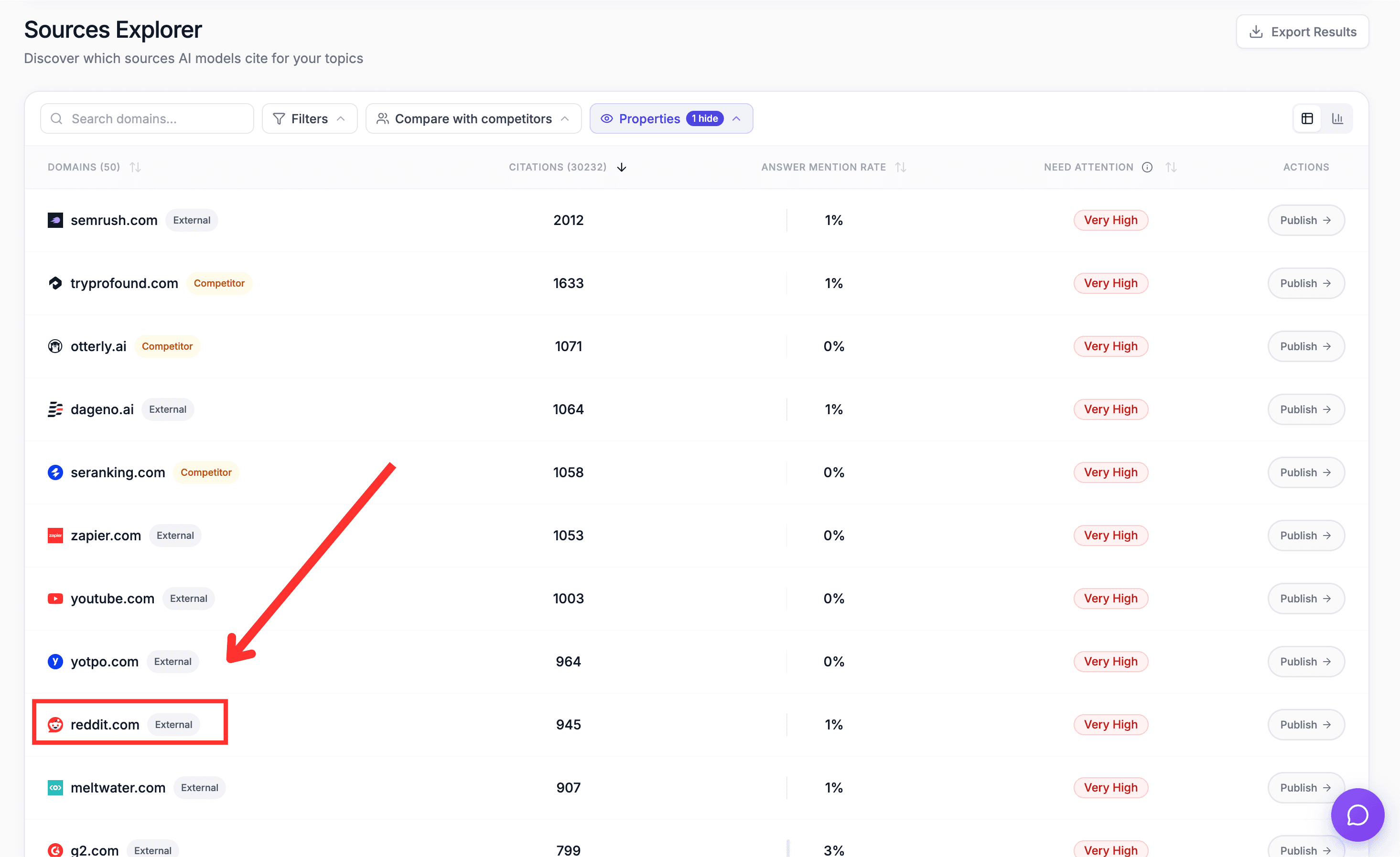
Complete the core sources work with a domain-level view: which domains, not just URLs, are cited most often as sources on your scope? Social platforms almost always emerge. Say Reddit shows up as the third most-cited domain on your scope. That tells you Reddit content is actively shaping the answers your buyers see.
Analyze your Reddit presence
Drill into Reddit: identify the exact subreddits and threads that influence LLM answers on your scope. This is not anecdotal. A Search Engine Land study found that AI search engines cite Reddit more than any other source.
Why Reddit matters : Reddit is "pure" conversation between real users. People debate, argue, and recommend products and services to each other, which creates genuine information. That carries real weight in the comparative logic LLMs use when they suggest options.
From this data, build a concrete action list:
Comment on the specific threads that already influence answers on your scope.
Develop discussions in the subreddits that surface most often.
Keep it genuine: a promotional tone gets downvoted and moderated out, which kills the very signals that make Reddit influential.
Reddit is usually the most influential social platform, but others can emerge on your scope.
Analyze your presence on other social platforms
Run the same logic on LinkedIn and YouTube:
Check whether they surface in your core sources.
Find the exact profiles, posts, or videos that already influence answers.
Decide where to show up or reinforce your presence.
The mechanics differ by platform, but the question stays the same: are the pages that shape AI answers ones you control or influence?
Step 9 : Analyze AI Answer Quality
Visibility on its own is not enough. Being mentioned often with the wrong message, or with negative sentiment, can hurt more than it helps. This is why an AI visibility monitoring platform has to combine share of voice, sentiment and brand alignment in the same view.. This is where the alignment and sentiment scores come back into play, this time as a way to dig into the substance of the answers and trace the pages behind a bad result.
Is the LLM response aligned with your core messaging?
Alignment is the metric that tells you whether the way engines describe your products and brand matches the messaging you actually push. Read the score per topic first, then open the answers behind it.
When alignment drops, the engine is pulling its description from somewhere: an outdated page of yours, a third-party site running old positioning, a competitor's framing. The score points you to the problem, the answers tell you the cause. Trace it back to the source pages so you can correct your own content or go influence the external one.
Is the LLM response positive or negative about your brand?
Sentiment is the metric that tells you whether engines speak about your brand positively or negatively. Same method: start from the score, then open the answers that drag it down.
This is where it gets actionable. Identify the exact pages that tarnish your sentiment. They are usually:
Negative reviews on sites like G2, Capterra or Trustpilot
Critical Reddit or forum threads
Outdated articles still carrying an old problem
Once you have that list, you can act on each source: respond, request a correction, publish fresher content, or work the page down the rankings.
Step 10 : Analyze your Entity Recognition and Topic Association
Entity recognition is about whether engines actually understand who your brand is and what it does. LLMs and search engines build a model of every brand from authority graphs and reference sources. If your brand entity is not clearly connected to the key entities of your topic, you stay a weak candidate for the answer, even with strong content.
The goal is to check how tightly your brand is associated with your topic's entities, then reinforce the links that are missing. You audit this through the proxies engines rely on to tie a brand to entities:
Wikipedia / Wikidata : does your brand page exist, and is it linked to the key entities of your topic? A page that never mentions your category leaves the association to chance.
Google Business Profile : is your brand correctly categorized and connected in Google's knowledge graph?
LinkedIn and other social profiles : do they describe the products and services tied to your topic, in plain terms?
Comparison sites : check your company description on every comparator and directory where you appear. Vague or outdated descriptions weaken the association.
Across all of them the question is the same: is your brand consistently described as part of your topic, with the same entities, everywhere engines look?
The action: fix and enrich each proxy so your brand entity is tightly bound to the entities that define your topic.
Step 11 : Formalize your GEO strategy and roadmap
A GEO audit is the foundation of your GEO strategy. It hands you the priorities, and the next move is turning them into a roadmap.
By this point you have identified the axes that matter most for your visibility in generative AI. Group them into a clear roadmap:
Technical fixes : crawl access, rendering, content structure.
Content to optimize : transactional and informational pages already live.
Content to create : new transactional and informational pages to fill the gaps.
Social platform actions : Reddit threads and subreddits, plus any other platform that surfaced on your scope.
Entity-level actions : Wikipedia, knowledge graph, and the proxies that define your brand.
Building that strategy out is its own exercise. See our guide to building a GEO strategy.
Who should conduct a GEO audit?
A GEO audit can be run three ways, depending on your resources and your maturity on the subject.
In-house
Running it yourself takes real skills: defining the scope, handling the technical analysis, and reading the data across several engines. In practice it means having a SEO/GEO manager who owns the discipline. The upside is full control and continuity over time. The catch is that GEO is still new, so this expertise is rare and hard to hire.
With a GEO tool
Most teams lean on a dedicated GEO platform to collect the data and structure the analysis. A tool typically lets you:
Run your prompts across every engine
Track share of voice, citations, mentions, alignment and sentiment
Surface your core sources and content gaps in one place
Some tools go further and support their users directly on enterprise plans, pairing the platform with hands-on help. GetMint works this way: it monitors and improves brand visibility across AI engines (ChatGPT, Claude, Gemini, Perplexity and AI search features), and on enterprise plans you can be supported by a GEO expert who runs the audit with you, end to end.
With an agency or freelance
You can also outsource the audit to a GEO agency or a freelance specialist. The setup is usually the same: they scope the topics and prompts with you, run the analysis on their own stack, then hand back a prioritized roadmap. It's a good fit when you want the expertise without building it in-house, or when you just need a one-off baseline before deciding whether to internalize the discipline.
Why use a GEO audit tool?
Running the eleven steps by hand is heavy. You would play every prompt across each engine, many times over, just to get past the impermanence of the answers. Then dedupe, score share of voice, pull citations and mentions, and map your core sources and content gaps, topic by topic and prompt by prompt. A GEO tool does that work for you, and on a continuous basis instead of a one-off snapshot.
GetMint covers the full chain in one place:
Detect AI Opportunities to build your topics and prompts
Monitor AI Visibility for share of voice, citations, mentions, alignment and sentiment
Citations Flow to see whether your visibility is on-site or external
Content Studio to close content gaps at scale
A 150K+ partner media network to earn mentions
Expert support on enterprise plans to run the audit with you
What are the benefits of a good GEO audit?
A good Generative Engine Optimization audit turns AI visibility into something you can act on. It gives you:
A precise read of your brand's visibility across AI engines
Content gaps to close, topic by topic and prompt by prompt
Mention gaps and a clear list of sources to target
A check on whether LLMs actually respect your messaging
The web pages dragging your sentiment down
A view of the traffic and conversions AI engines already send you
A prioritized roadmap, ranked by impact
FAQ on GEO Audit
How often should I run a GEO audit?
Run a full GEO audit once a quarter. AI answers shift constantly and the engines change fast, so a quarterly deep dive keeps your baseline honest. In between, track your scope continuously with a tool instead of waiting three months to catch a drop. Re-audit sooner after a major site change, a rebrand, or a new product launch.
What is the cost of a GEO audit?
It depends on how you run it:
In-house : your team's time plus a GEO tool subscription, usually a few hundred to a couple thousand dollars a month.
Agency or freelance : a one-off audit from $3,000 to $10,000+, depending on the number of topics and prompts.
Enterprise plan : the tool plus expert support, recurring, often from $1,000 to several thousand a month.
How long should a GEO audit take?
Plan one to two weeks for a first full audit. Scope definition and data collection take the most time, since you need to run your prompts enough times to get a stable read. The analysis and roadmap come quickly once the data is in. With a tool, data collection is automated, which can cut a first audit down to a few days.
START FREE. NO CREDIT CARD REQUIRED.
Your competitors are already visible in AI. Are you?
See what ChatGPT, Gemini and Perplexity say about your brand. Set up in 5 minutes.

