


Nearly 60% of all Google searches now end without a click. This single statistic is redefining the meaning of “search visibility.” When users get their answer directly on the results page, ranking in the blue links is no longer enough to win.
The new measure of influence is the AI citation. Getting your content cited directly by AI models is the best way to prove your authority and reach users.
To go from being just another source to becoming the source, you must understand what an AI citation is and what makes a piece of content valuable enough for an AI to feature it.
What Is an AI Citation?
An AI citation is a direct, linked reference from an AI-generated answer back to a source webpage. It’s the AI showing its work by crediting the specific source it used.
You’ll most often see these in AI search engines like Perplexity or LLMs with the Search tool enabled (ChatGPT, Gemini, etc.).

AI citations are different from AI mentions.
A mention is an unlinked reference to your brand, whereas an AI citation is the direct, measurable proof that your content was used as a factual source.
What Makes Content Citable by AI?
AI models don’t choose their sources at random. They’re designed to find the most direct path to a trustworthy answer, and that path is guided by four principles.

1. Comprehensive Depth
AIs ignore shallow content. They’re designed to find the most complete and definitive answer to a user’s query. This is why pages that give full answers gain 26.7% better visibility in search.
Content that covers a topic thoroughly and anticipates follow-up questions is far more likely to be treated as an authoritative source.
→ For example, a 500-word article that only defines “content marketing” is unlikely to be cited. A 3,000-word pillar page that defines it, explains its history, details different strategies, and provides a framework to measure ROI is a citable asset.
2. Clear Structure
AIs don’t read content; they parse it. A logical, clean HTML structure shows that your content is well-organized and trustworthy.
Your headings should form a clear outline of your argument (going from H1 to H4 without skipping levels), and complex ideas should be broken down into scannable, modular formats, where each section can be read on its own.
AI-generated answers use lists approximately 78% of the time, so it helps to make your content easier to extract by using numbered lists, bullet points, and strategic bolding.
→ Instead of writing, “A good content strategy involves research, creation, distribution, and analysis,” structure it as a bulleted list. The AI can easily lift this clean, structured format for a step-by-step answer.
3. Verifiable Authority
Due to their skeptical nature, AIs cross-reference information and look for traditional signals of credibility to validate a source.
Your foundational SEO efforts are important here. If you’ve built a strong backlink profile, clear author expertise (E-E-A-T), and a history of reliable content, you’ll signal to the AIs that your information can be trusted.
→ For example, a weak claim like “Studies show AI is growing” will be ignored. A strong, citable claim is “According to Backlinko’s 2025 SEO study analyzing 11.8 million Google search results, the #1 result in Google has an average of 3.8x more backlinks than positions #2–#10,” with a direct link to the report.
4. Quote-Worthy Language
AIs favor content that’s explained in a conversational tone and that can be quoted with confidence.
This means your writing should be direct, factual, and unambiguous. Instead of using weak or hedging language (”It seems like a good SEO strategy might help your Verifiable Authority”), use clear, declarative sentences that can be lifted and used as a standalone fact.
To learn more about what makes content attractive to AIs, read our guide covering Generative Engine Optimization (GEO).
3 Steps to Start Earning AI Citations
Earning an AI citation is the result of a deliberate, repeatable process.
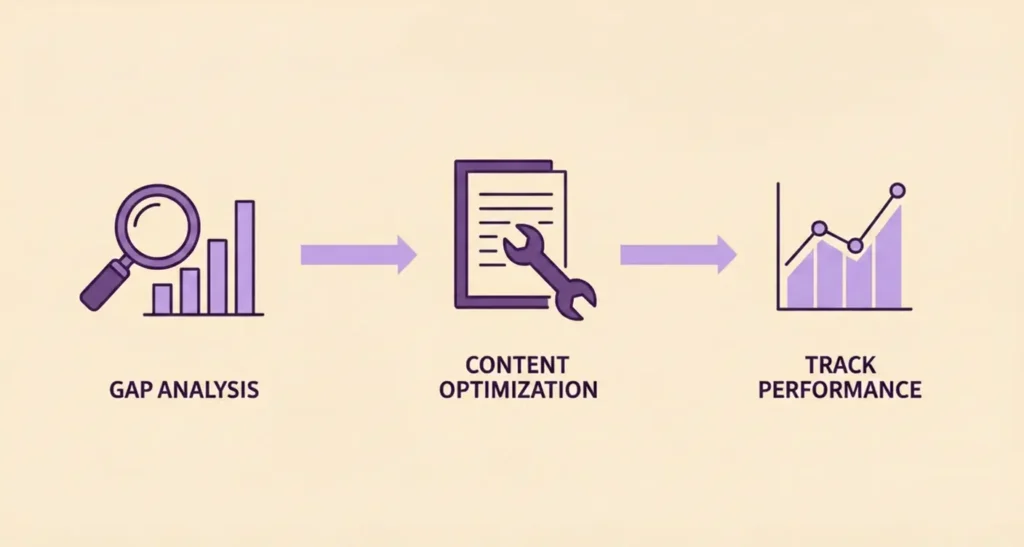
You don’t need to create a new content strategy from scratch. Instead, you can follow this simple, three-step workflow to begin optimizing existing content for AI search and tracking your performance.
Step 1: Conduct a Gap Analysis
Your first job is to find your opportunities. Start by asking the AI platforms (like ChatGPT and Perplexity) the same questions your customers ask.
- “What is the best [product category] for [use case]?”
- “How do I solve [common problem]?”
- What is the difference between [concept A] and [concept B]?”
Take note of which competitors are being cited and for what topics. These are your immediate targets where your voice is missing.
Pro Tip: GEO platforms like GetMint can surface the exact prompts users send to AI engines so you can spot where competitors are being cited and where your brand is missing.
Step 2: Optimize Your Content for Extraction
Once you’ve identified a page that should be earning a citation, your goal is to make it as easy as possible for an AI to extract the answer. Go back to your existing article and:
- Insert a clear “answer block.” Write a concise, 40- to 60-word paragraph that directly answers the target question and place it directly below the most relevant heading. This helps optimize for answer engine visibility.
- Add structured data. Use FAQPage Schema to programmatically label the questions and answers on your page. This removes all the guesswork for the AI.
- Strengthen your sources. Add links to authoritative, third-party data to back up your claims and reinforce your credibility.
Step 3: Track Your Performance
You’ll need new analytics to measure AI search visibility. Tools like Google Analytics are blind to AI citations and mentions because they only track clicks. This is a blind spot, especially as some analyses estimate that organic web traffic is down by 15% to 25% due to AI-powered answers.
To see if your optimization efforts are working, you need a specialized AI citation tracking tool. This is the only way to get reliable data on your citation frequency, benchmark your performance against competitors, and prove the ROI of your GEO strategy.
How GetMint Helps You Track and Earn AI Citations
GetMint is a specialized AI visibility monitoring platform that gives you a complete picture of your performance across all major AI models.
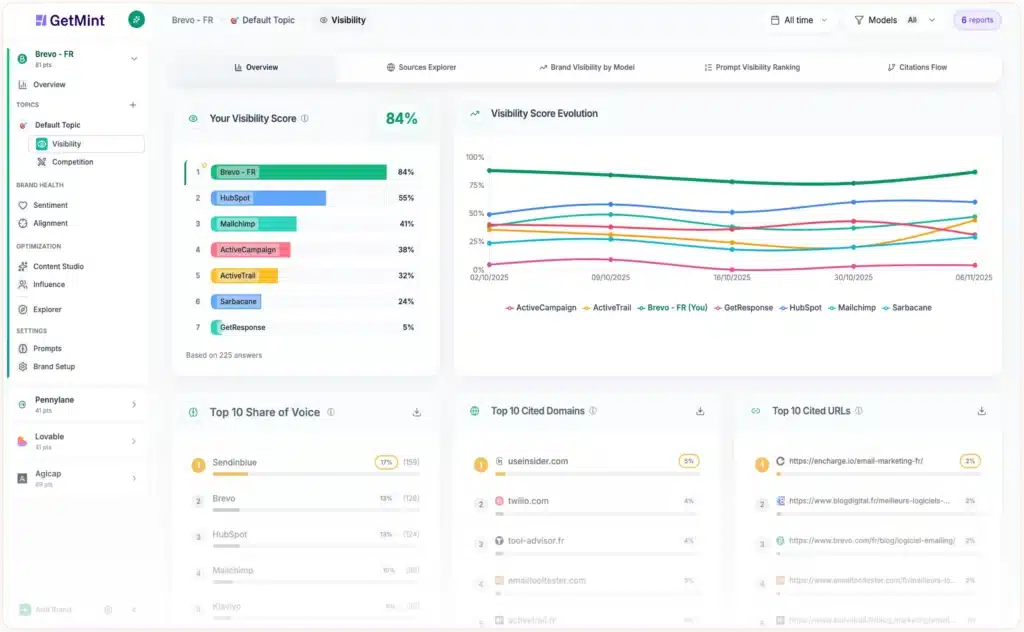
Instead of guessing, it lets you:
- Track your citation frequency over time to see the direct impact of your optimization efforts.
- Benchmark against competitors to identify the exact queries where they are being cited, giving you a targeted strategy to win those citations back.
- Analyze both citations and brand mentions to get a complete, unified view of your AI-driven reputation.
GetMint provides the data you need to make the AI citation a measurable, actionable part of your marketing strategy. Run your AI visibility audit today and see where you stand.
Frequently Asked Questions (FAQs)
What is the difference between an AI citation and an AI mention?
An AI citation is a direct, linked reference from an AI-generated answer back to a source webpage. It’s the measurable proof that your content was used as a source.
An AI mention is an unlinked reference to your brand, product, or expert. While citations are direct proof, mentions are a signal of brand authority.
What is the difference between AEO, SEO, and GEO?
AEO, SEO, and GEO are three disciplines that work together.
• SEO (Search Engine Optimization) helps you rank high in the traditional list of blue links and win the click.
• AEO (Answer Engine Optimization) helps you become the direct answer on a Google search results page (e.g., in a Featured Snippet).
• GEO (Generative Engine Optimization) helps you earn citations and mentions inside conversational AI platforms like ChatGPT.
How long does it take to get an AI citation?
You can see the impact of tactical changes, like adding an “answer block” to an existing high-authority page, in as little as a few weeks.
However, building the foundational authority needed to earn citations on competitive topics is a long-term effort that can take 3 to 6 months. While AI search traffic is still under 1% for most sites, it’s a long game, and starting now gives you the advantage.
Do AI citations help with SEO?
Indirectly, yes. While an AI citation itself is not a direct ranking factor for traditional search, the qualities that make content citable (authority, clear structure, and trustworthiness) are all signals for SEO.
Furthermore, the brand authority you build by earning citations can lead to an increase in branded searches over time.
What is the ROI of an AI citation?
The primary ROI of an AI citation is influence and authority. However, it also has a direct impact on revenue.
Visitors who do click through from an AI-powered answer are worth 4.4x more in version value than traditional organic traffic, as they’re often further along in their buying journey.

